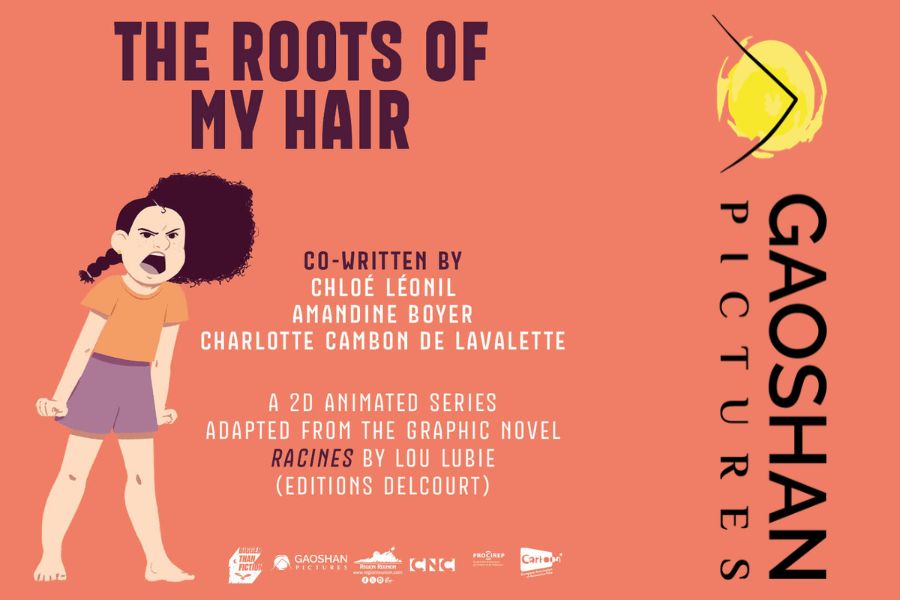
At last Cartoon Forum in Toulouse, Gao Shan Pictures pitched its new series Racines – The Roots of My Hair.
The Animation Journal met Bérangère Condomines, Head of Development and Producer, and Anne-Flore Aussant, Producer at Gao Shan Annecy, to discuss artistic identity, talent, and diversification.
Your work stands out for its quality and its variety of styles. What drives your approach?
We have two activities: the studio, often in co-production, and lead production.
As a studio, our hallmark is the diversity of art directions: this year, In Waves, Lucy Lost and Jim Queen; before that, Mars Express and Sirocco. 2D or 3D, we adapt. But every project must be strong, carry values we recognise ourselves in and be aesthetically demanding. That matters to our founder, Arnauld Boulard, and to all of us. The same goes for the projects we initiate, with particular attention to our relationship with authors and artists. We work with them for years, so it has to be a shared human adventure.
Singular projects aren’t easy to place in today’s market.
Singularity is what makes a work memorable. Audiences are tired of things that all look alike, and they remember distinctive works. For an independent like Gao Shan, it’s not a bad bet.
How do you work with talent?
There are no rules. We follow the needs of each project and of its authors and directors.
Over the years we’ve built trust with our partners and now with our talent. Kindness is one of our watchwords. We regularly check that we’re heading in the same direction, making the same film.
Producing is hard enough – you constantly have to defend the project – so if the internal relationship isn’t smooth, that’s a bad sign. You sense very quickly whether you share the same vision.
What’s on your development slate?
Two international features: Lou and the Glacier’ Secrets, a co-production with Switzerland
and Belgium by the Guillaume brothers, and Winter of the Holy Iron, adapted from a Lakota
novel and co-written by Ugo Bienvenu.
From Annecy, we’re developing Avocado Jackfruit, a kids’ series we pitched here last year, and Mini Rabbit, a preschool series based on picture books.
About books, many of your projects feel close to illustration. Would you consider publishing spin-offs?
We can easily see Avocado Jackfruit becoming graphic novels, either new stories or adaptations of the series. The Winter of the Holy Iron is on the table too, and the Guillaume brothers would be open to it. They made a book from a previous film. It interests us.
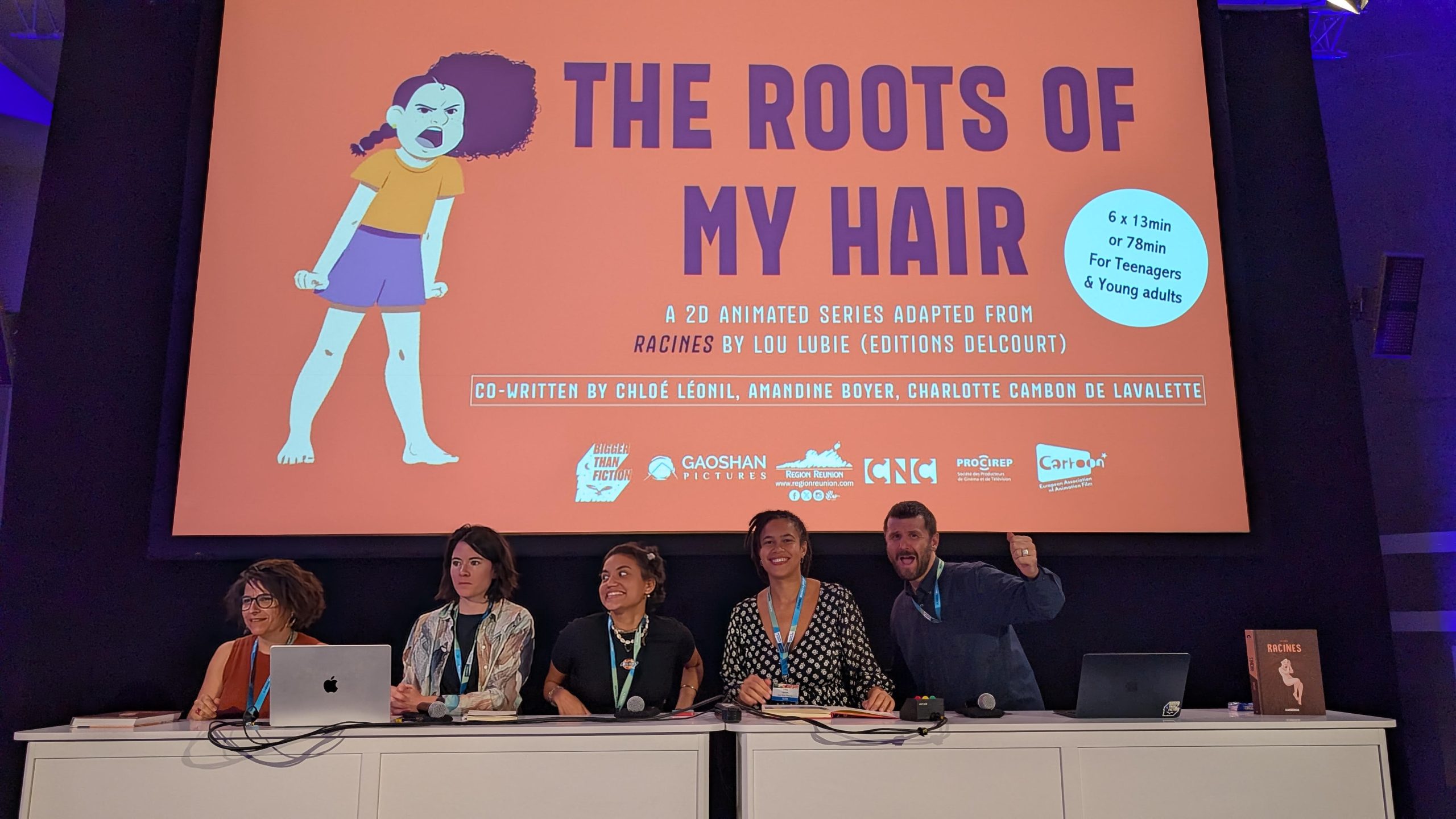
Tell us about Racines.
It adapts Lou Lubie’s graphic novel on textured hair, blending life stories and documentary information. We’ve made it a serialised show, 6 × 13’ or a 78’ special.
Rose, 30, living in Paris since her studies, returns to Réunion to confront her roots, literally: her hair comes to life and says enough about straightening and denying her Creole, Afro-descendant heritage.
It’s a political series for teens, but also a dramedy: Rose and her hair are a real comic duo. The pitch in Toulouse was also a reunion: the three authors, our co-producer Julien Aubert of Bigger Than Fiction, and I live in Réunion, Marseille, Lille and Montpellier, and after 18 months we’d never all been together.
The reception of our presentation was very warm. We’re halfway through development and are looking for a French broadcaster, an international distributor and a foreign co-producer.
We want the broadcaster to join development so we can make the first episode’s animatic together. Developing alone, hoping for a pre-sale, makes no sense.
What about the work lineup on the studio side?
We’ve finished Alain Gagnol’s feature Dog my cats! , we’re animating The Wolf for Xilam and working on the series The Baker Street Four, between Réunion and Angoulême.
From the outside, the crisis seems to pass you by.
It may look that way. But we also suffer from producers’ financing problems: schedules slip, and that hits us hard. We are also moving through video-game animation. We made Into The Wonderwoods entirely in Unreal, so our teams are ready.
Our first diversification was moving from features into series, which brings stability when they run for several seasons. That lets us keep making animated features that are all unique and take a long time to make.
Curated by Cristina Angelucci