The Moroccan director and founder of Oneiris Animation shares her approach to turning poetic language into cinematic imagery.

Sofia El Khyari is a Moroccan animation director and artist, and the founder of Oneiris Animation, the country’s first production company dedicated to independent auteur animation. Her films have screened at Locarno, TIFF and Annecy, and have been exhibited at institutions including the Institut du Monde Arabe, the Musée du Quai Branly-Jacques Chirac and the Cinémathèque Française. Working between filmmaking and visual art, she focuses on atmosphere, authorship and poetic storytelling, and as both director and producer she has helped shape a distinct space for independent animation in Morocco and beyond. At SACC, she brings her beginner workshop From Poem to Storyboard, meant to look at how poetry can inspire visually driven storytelling, by discussing how verse is interpreted into visual metaphors and how sound and image interact to create mood.
What is one misconception about adapting poetry into animation that you often encounter, and what would you encourage beginners to think about differently when approaching this process?
I think one of the biggest misconceptions is that adapting poetry into animation means illustrating the poem, translating its words into images one by one. For me, poetry is much more than what it describes; it is also what it evokes, what it leaves unsaid, and the sensations it awakens in us.
I would encourage beginners to approach a poem as a space to explore rather than a story to explain. Animation is particularly suited to this process because it allows us to create our own very particular world, play with time, and give movement to things that might otherwise remain invisible. Ultimately, I think the goal is not to reproduce the poem, but to reinterpret it, allowing the film to become a poem in its own right.

When adapting a poem into animation, do you usually begin by focusing on its emotion, imagery, narrative, or rhythm, and how do you then translate those elements into visuals without making the interpretation feel too literal or losing the ambiguity of the original poetic language?
For me, these elements are inseparable, and I don’t necessarily begin with one of them consciously. My films often start with a feeling or a mental image that stays with me, sometimes long before I fully understand what it means. I then explore this initial intuition through writing, drawing, and experimentation, allowing the imagery, rhythm, and emotional landscape to develop together.
I try to find visual equivalents for the experience of the poem rather than illustrations of its content; a particular texture might evoke a memory, while a movement or a change in rhythm might express the passing of time. I also like to leave room for the unexpected, allowing images to transform, disappear, or acquire meanings that were not present at the beginning. I think ambiguity is essential because it invites the audience to bring their own memories and imagination into the film, rather than simply receiving a predetermined interpretation. For me, the challenge is to create a visual language that is precise in its sensations but remains open in its meaning, which is ultimately the purpose of poetry.
Could you walk us through one of your own films and explain how an initial poetic idea developed into the final visual language? And how has your approach changed as you’ve made more films?

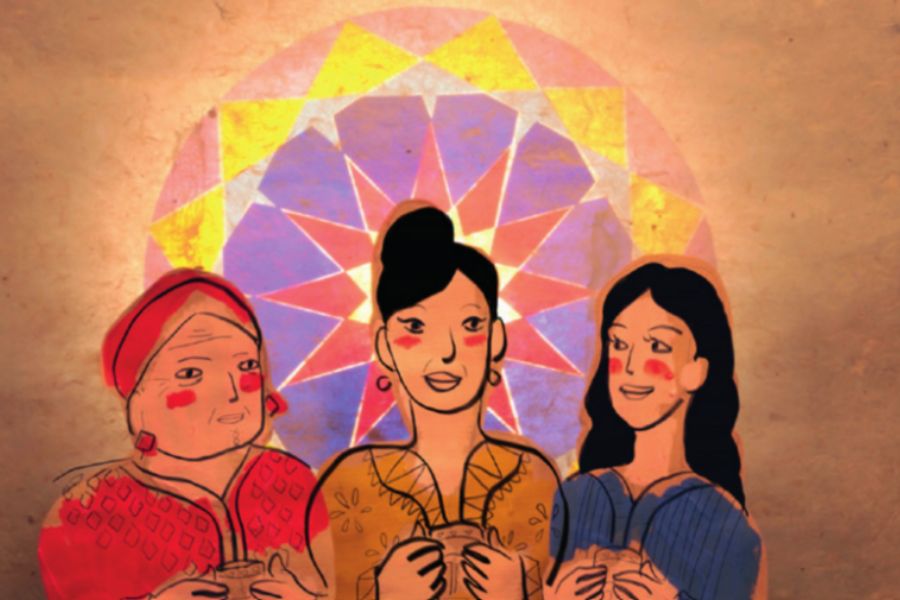
In Shadow of the Butterflies, the initial impulse came from a period of transition in my life, as I was moving away from London and reflecting on displacement, memory, and the bittersweet feeling of nostalgia. I was particularly drawn to the Portuguese concept of saudade, which captures the tenderness and melancholy of longing for something absent or irretrievably lost, and immersed myself in the poetry of Fernando Pessoa.
As I was drawing the initial images for the film, I was also writing poems of my own. This gave birth to the film’s soundtrack: a musical poem in Moroccan Darija, composed with Widad Brocos and Khalil Epi, the duo behind the renowned Moroccan band Aita Mon Amour. The music complemented the images, bringing a different emotional tone and completing the visual poem. Most of my films emerge from this duality of drawing or painting and writing. I enjoy exploring materials, textures, colours, sounds, and words as part of my poetic palette.
Ultimately, poetry speaks to the soul; it is an intuitive process.